

Modern businesses face a critical infrastructure dilemma that directly impacts their bottom line and operational resilience. According to recent industry data, organizations that adopt structured managed services see an average 30% reduction in unplanned downtime compared to those relying on reactive fixes. This statistic highlights the growing shift away from traditional break-fix models toward proactive support strategies. As technology becomes more complex, the choice between maintaining an internal team, hiring freelancers on demand, or partnering with a managed service provider (MSP) is no longer just about cost. It is about security, scalability, and strategic alignment. This guide dissects these three models to help you determine the optimal path for your organization's growth.
Understanding the Core IT Models
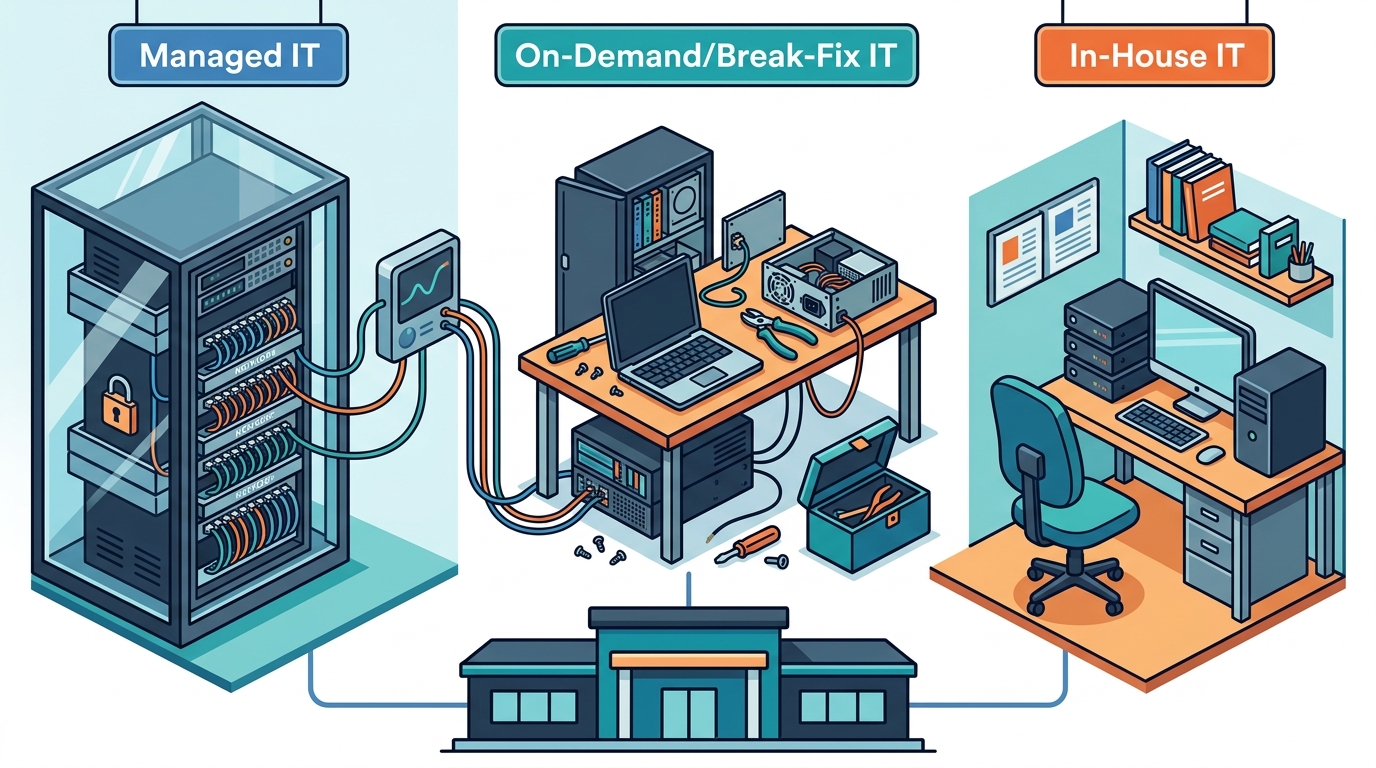
Before diving into the specifics, it is essential to define the operational boundaries of each approach. Managed Services is a proactive IT model where a third-party provider monitors, manages, and maintains your technology infrastructure on a subscription basis. On-Demand IT refers to a flexible engagement model where businesses hire external experts for specific, short-term projects or urgent issues without long-term commitments. In-House IT involves employing full-time staff members to manage all technical operations internally, offering direct oversight but requiring significant resource investment.
Each model serves a different business maturity stage. Startups often lean toward on-demand flexibility, while established enterprises may require the robust security of managed services or the specialized control of in-house teams. Understanding these definitions is the first step toward making a data-driven decision.
Managed Services: Proactive Protection
Managed services have become the gold standard for businesses seeking predictable costs and enhanced security. Instead of waiting for systems to fail, an MSP like Techtality monitors your network 24/7 to prevent issues before they occur. This proactive approach significantly reduces the risk of catastrophic data breaches, which cost the average company millions in damages and reputational loss.
Cost Predictability and Scalability
One of the primary advantages of managed services is the flat-fee subscription model. This structure allows businesses to budget IT expenses accurately, avoiding the surprise invoices common in break-fix scenarios. Furthermore, managed services scale effortlessly. As your company grows, your IT support grows with you, eliminating the need to recruit and train new staff members for every new hire.
Security and Compliance
Security is not an afterthought in managed services; it is the core product. Providers implement advanced threat detection, regular patch management, and automated backups. According to cybersecurity reports, businesses with managed security services are significantly less likely to fall victim to ransomware attacks. This level of protection is often unattainable for small to mid-sized businesses operating without a dedicated security team.
On-Demand IT: Flexibility and Speed
On-demand IT services cater to businesses with fluctuating needs or specific project-based requirements. This model is ideal for companies that do not need daily support but require expert intervention for critical tasks such as cloud migrations, software implementations, or emergency repairs.
Agility and Specialized Expertise
The primary benefit of on-demand IT is agility. You can access specialized skills for a short period without the overhead of a full-time salary. For example, if you need to implement a new ERP system, you can hire a specialist for the duration of the project. This approach ensures you get top-tier expertise exactly when you need it, without the long-term financial burden.
Limitations in Continuity
However, on-demand IT lacks the continuity of managed services. Because the relationship is transactional, there is often a learning curve each time a new provider engages with your systems. This can lead to slower resolution times for recurring issues and a lack of deep institutional knowledge about your specific business context.
In-House Teams: Total Control
Building an in-house IT team offers the highest level of control and customization. Internal staff are deeply embedded in your company culture and understand your unique business processes intimately. This alignment can lead to more tailored solutions and faster communication during critical incidents.
Deep Institutional Knowledge
In-house teams develop a nuanced understanding of your legacy systems and proprietary workflows. This knowledge is invaluable for complex integrations and custom development projects. Additionally, having IT staff on-site can enhance security protocols by managing physical access and monitoring internal network traffic directly.
High Operational Overhead
The drawbacks of in-house IT are substantial. Recruitment, training, and retention costs are high. Furthermore, maintaining a team with diverse skills (networking, security, helpdesk, development) is challenging. If a key team member leaves, you may face significant gaps in coverage. According to workforce data, the average cost of replacing an IT professional can exceed their annual salary when factoring in recruitment and lost productivity.
Comparative Analysis: Cost and Control
To help you visualize the differences, here is a summary of the key factors across the three models.
| Factor | Managed Services | On-Demand IT | In-House IT |
|---|---|---|---|
| Cost Structure | Predictable monthly subscription | Pay-per-use or project-based | High fixed salary and benefits |
| Response Time | Proactive monitoring and SLA-backed | Variable based on availability | Immediate and on-site |
| Expertise Breadth | Wide range of specialized skills | Specific to project needs | Limited by team size |
| Scalability | Highly scalable | Moderate | Low (requires hiring) |
| Security Focus | Enterprise-grade proactive defense | Reactive or project-specific | Dependent on staff capability |
Key Takeaways
- Cost Efficiency: Managed services often provide the best ROI for small to mid-sized businesses by converting variable costs into fixed expenses.
- Security Posture: Proactive monitoring in managed services significantly reduces the risk of data breaches compared to reactive models.
- Flexibility: On-demand IT is ideal for short-term projects but lacks the continuity needed for daily operations.
- Control: In-house teams offer deep customization but come with high recruitment and retention challenges.
- Scalability: Managed services allow for seamless scaling of IT resources as your business grows.
- Expertise Access: MSPs provide access to a broad spectrum of specialized skills that are difficult to maintain in-house.
- Strategic Focus: Outsourcing IT allows leadership to focus on core business activities rather than technical troubleshooting.
Frequently Asked Questions
What is the primary difference between managed and on-demand IT?
Managed IT is a proactive, subscription-based model focused on prevention and continuous monitoring. On-demand IT is a reactive, transactional model where you hire experts only when specific issues arise or projects are needed.
Is managed IT more expensive than having an in-house team?
For most small to mid-sized businesses, managed IT is more cost-effective. The combined cost of salaries, benefits, training, and software licenses for an in-house team often exceeds the flat fee of a managed service provider.
Can I switch from on-demand to managed services later?
Yes, many businesses start with on-demand IT and transition to managed services as they grow. This hybrid approach allows you to manage initial costs while building a foundation for long-term stability.
How does managed IT improve cybersecurity?
Managed providers implement advanced threat detection, regular patch management, and automated backups. This proactive stance prevents many attacks before they can cause damage, which is often beyond the capability of small in-house teams.
What types of businesses benefit most from on-demand IT?
Businesses with fluctuating workloads, specific project-based needs, or those that do not require daily support benefit most from on-demand IT. It offers flexibility without the overhead of full-time staff.
Does managed IT include data backup and recovery?
Yes, comprehensive managed services typically include robust data backup and disaster recovery planning. This ensures your business can quickly resume operations after any unforeseen event.
How do I choose the right IT model for my company?
Consider your budget, growth stage, security needs, and internal expertise. If you need predictable costs and proactive security, managed services are likely best. If you have specific, short-term needs, on-demand may be sufficient.
Next Steps
Choosing the right IT model is a strategic decision that impacts your entire organization. At Techtality, we specialize in helping businesses navigate this complexity. We offer tailored managed IT services designed to enhance your security and operational efficiency. If you are unsure which path is right for you, schedule a free consultation with our experts today. Let us help you build a resilient IT infrastructure that supports your long-term goals.