

How Do I Transition My Office to VoIP Phone Services?
Business communication is undergoing a massive shift. According to recent market data, the global VoIP market is projected to grow significantly as companies prioritize flexibility and cost-efficiency over traditional hardware. For Arizona-based businesses, this transition is not just about saving money. It is about future-proofing your operations against downtime and enabling seamless remote work capabilities.
Understanding VoIP Technology
Before you make any physical changes, you must understand what you are adopting. VoIP, or Voice over Internet Protocol, is a technology that allows you to make voice calls using a broadband Internet connection instead of a regular, or analog, phone line. Investopedia defines VoIP as a method for conducting communications where voice data is transmitted over the internet rather than through the public switched telephone network (PSTN). (Why Choose US All)
This fundamental shift offers several immediate advantages for businesses. You gain mobility, allowing employees to take their office number anywhere. You reduce costs by eliminating long-distance fees and expensive hardware maintenance. Most importantly, you integrate communication with your existing business tools, such as CRM systems and email platforms. (Business Technology Services In)
Assessing Your Current Infrastructure
The first step in any successful technology transition is a thorough audit. You cannot build a new foundation on a cracked floor. At TECHtality, we begin every engagement by evaluating your current setup to identify potential bottlenecks. (Technology Services All your)
Network Bandwidth Analysis
VoIP requires a stable and robust internet connection. If your current bandwidth is insufficient, calls will suffer from latency, jitter, or packet loss. You need to calculate the required bandwidth based on the number of concurrent users. Generally, a single HD voice call requires approximately 100 kbps of bandwidth. For a small office of 20 users, this might seem manageable, but you must account for peak usage times and other data-heavy applications.
Existing Hardware Inventory
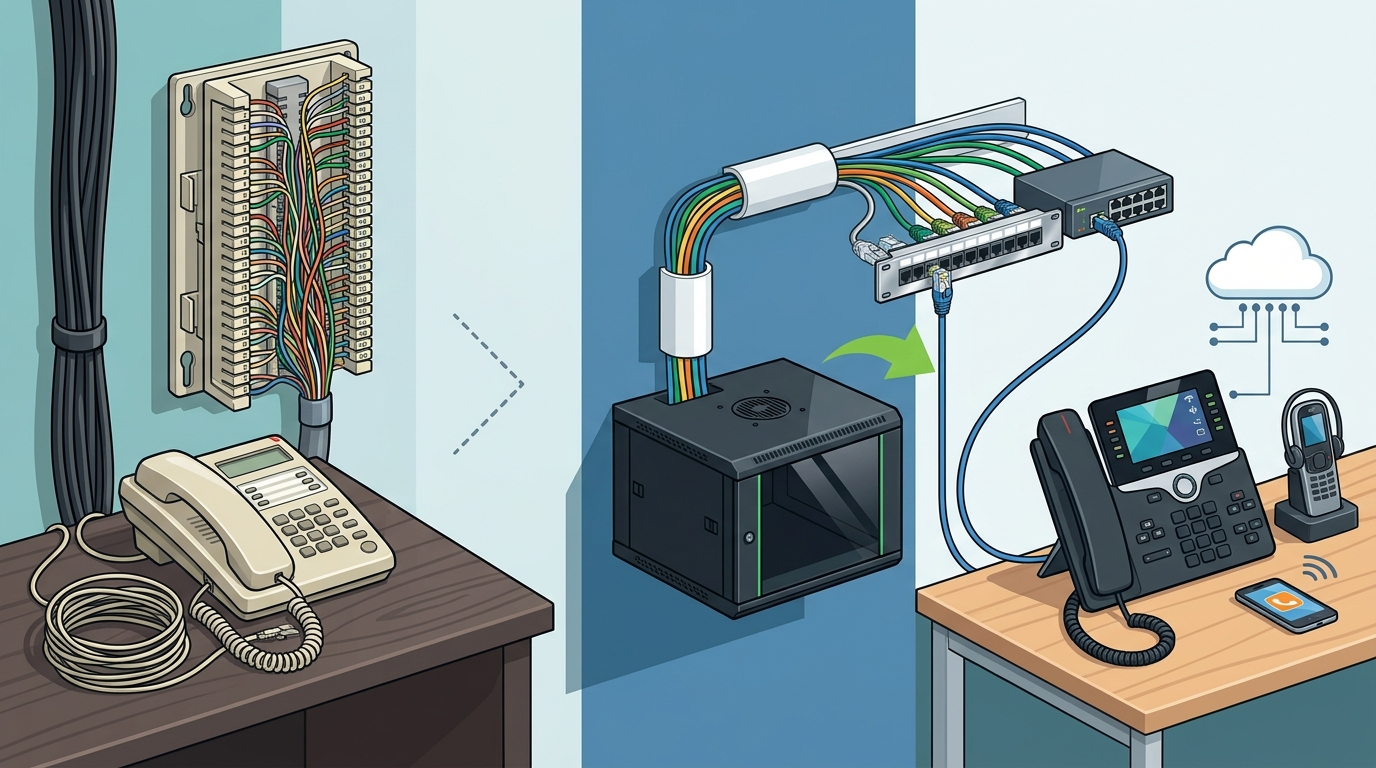
Do you need to throw away your current phones? Not necessarily. Many modern VoIP systems support IP phones that can be reused if they are compatible. However, older analog phones will require adapters or complete replacement. Assessing your inventory helps you budget accurately for the transition.
Selecting the Right Provider
Choosing a VoIP provider is a strategic decision that impacts your daily operations for years to come. You are not just buying a phone service; you are buying a partnership.
Local Expertise Matters
For businesses in Arizona, working with a local provider like TECHtality offers distinct advantages. Local experts understand the regional infrastructure challenges and can provide on-site support that remote-only providers cannot. Arizona business journals highlight the importance of local tech support for maintaining operational continuity.
Service Level Agreements (SLAs)
Review the provider's SLA carefully. What is their uptime guarantee? How quickly do they respond to critical outages? TECHtality has been providing managed support services since 1983, ensuring that reliability is baked into our service model. We offer comprehensive MSP on-site, on-demand, and remote IT services to ensure your phone system never goes dark.
Planning the Migration
A poorly planned migration can lead to days of lost productivity. A structured approach minimizes disruption and ensures a smooth handover.
Phased Rollout Strategy
Instead of switching everyone at once, consider a phased rollout. Start with a pilot group of tech-savvy users who can provide feedback and troubleshoot issues. This group acts as your internal champions, helping to normalize the new system for the rest of the office.
Data Migration and Number Porting
You will need to port your existing phone numbers to the new provider. This process can take anywhere from a few days to several weeks. Initiate this process early to avoid gaps in service. Ensure that all call routing rules, voicemail configurations, and auto-attendant menus are replicated in the new system before the cutover date.
Hardware and Network Requirements
VoIP is not just software. It requires specific hardware and network configurations to function optimally. Understanding these requirements is critical for a successful deployment.
Quality of Service (QoS)
QoS is a network management technique used to give priority to specific types of data. For VoIP, this means prioritizing voice traffic over less critical data like file downloads or video streaming. Without QoS, your calls may sound choppy during peak internet usage times. TECHtality can configure your routers and switches to ensure voice traffic always takes precedence.
Power over Ethernet (PoE)
Many modern VoIP phones use PoE, which allows them to receive power and data through a single Ethernet cable. This simplifies installation and reduces clutter. However, you need PoE-enabled switches to support this feature. If your current switches do not support PoE, you will need to upgrade them or use power injectors.
Comparison of VoIP Deployment Options
| Deployment Type | Description | Best For | Cost Profile |
|---|---|---|---|
| Hosted VoIP | Cloud-based service managed by the provider | Small to medium businesses | Monthly subscription |
| On-Premise PBX | Hardware installed and maintained on-site | Large enterprises with IT staff | High upfront capital |
| Hybrid VoIP | Combination of on-site and cloud features | Businesses with legacy hardware | Mixed model |
Training Your Team
Even the best technology fails if users do not know how to use it. Training is often the most overlooked aspect of a VoIP transition. Employees need to understand how to make calls, transfer calls, set up voicemail, and use advanced features like video conferencing.
Documentation and Support
Provide clear, easy-to-read documentation. Create quick-reference guides for common tasks. TECHtality offers dedicated support to help your team navigate the new system. We provide on-site and remote assistance to ensure that your staff feels confident and supported during the transition period. Forbes reports that user adoption is key to tech ROI, making training a critical investment.
Frequently Asked Questions
How long does it take to switch to VoIP?
The timeline varies based on the size of your office and the complexity of your current system. A small office with simple needs can be migrated in a few days. Larger organizations with complex auto-attendants and call routing may take several weeks. TECHtality manages the entire process to minimize downtime.
Will VoIP work during a power outage?
VoIP requires internet and power to function. If your internet goes down, your VoIP service will stop. However, you can mitigate this risk with backup power solutions like UPS (Uninterruptible Power Supply) and redundant internet connections. TECHtality can help you design a resilient network infrastructure.
Can I keep my existing phone numbers?
Yes, you can port your existing phone numbers to a new VoIP provider. This process is regulated by the FCC and must be handled carefully to avoid service interruptions. We handle the porting process for you.
Is VoIP secure?
VoIP can be secure, but it requires proper configuration. Encryption protocols like SRTP (Secure Real-time Transport Protocol) protect voice data from interception. TECHtality implements robust security measures to protect your communications from cyber threats.
What is the cost of VoIP?
VoIP is generally more cost-effective than traditional phone systems. Costs include monthly subscription fees per user, hardware costs if needed, and internet bandwidth. The savings come from reduced long-distance charges and lower maintenance costs.
Do I need a new internet connection?
Not necessarily, but you may need to upgrade your bandwidth. A professional assessment can determine if your current connection is sufficient for VoIP traffic without impacting other business operations.
How do I choose between hosted and on-premise VoIP?
Hosted VoIP is ideal for businesses that want low upfront costs and minimal maintenance. On-premise VoIP is better for organizations that require complete control over their hardware and data. TECHtality can help you evaluate your specific needs to make the right choice.
Contact TECHtality for Your Transition
Transitioning to VoIP is a significant step toward modernizing your business communications. With over 40 years of experience supporting Arizona businesses, TECHtality is your trusted partner for this journey. We provide comprehensive MSP on-site, on-demand, and remote IT services to ensure your transition is seamless and efficient.
Do not let technology challenges slow down your growth. Contact TECHtality today to schedule a consultation. Call a TECH at (480) 988-0900 or visit our contact page to get started. Let us help you build a resilient, flexible, and cost-effective communication system for your business.