

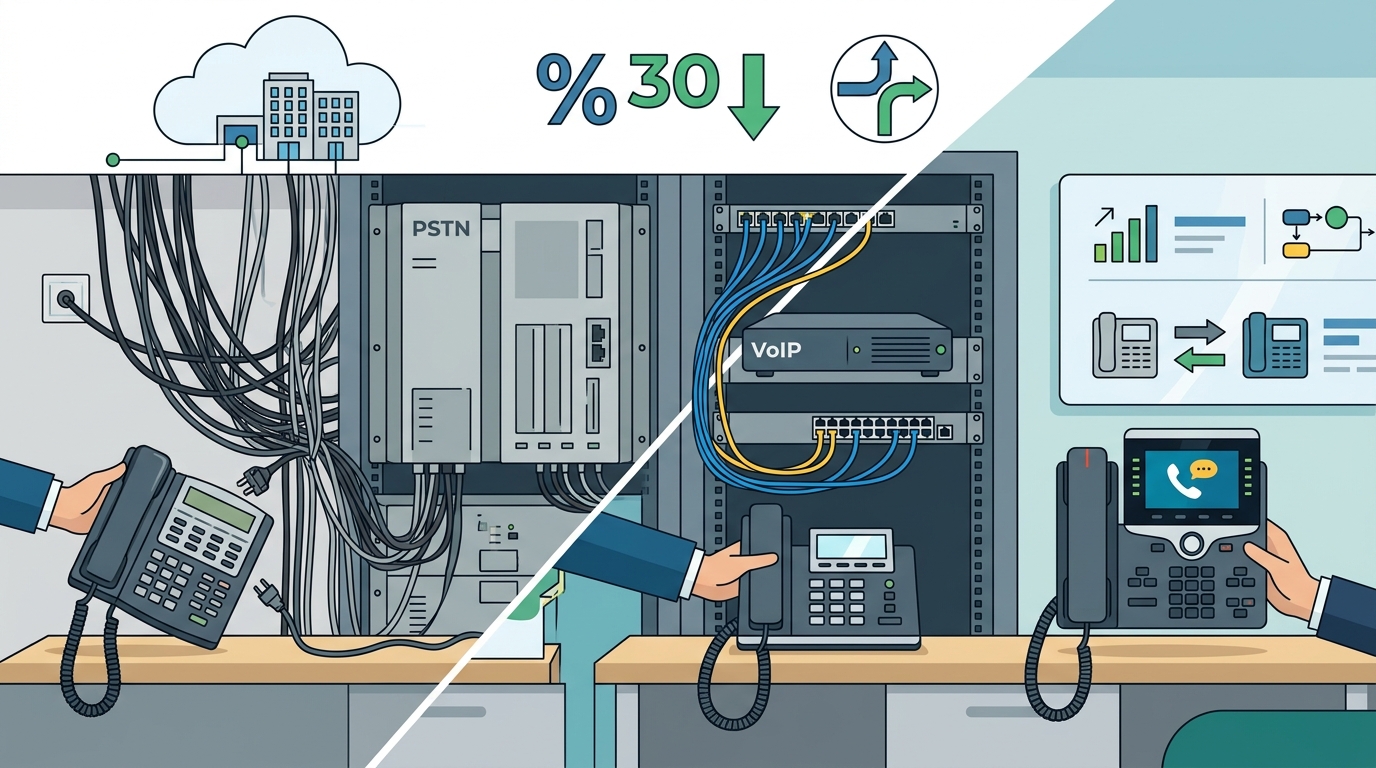
According to industry data, modern enterprises report a thirty percent reduction in communication overhead after migrating to cloud telephony. This shift eliminates legacy hardware costs while improving call routing efficiency. Businesses adopting digital voice protocols experience faster customer response times and streamlined IT management. The migration process requires careful bandwidth assessment and structured hardware replacement. Organizations that follow a phased deployment strategy minimize operational disruption. Your team can maintain continuous service while upgrading to next-generation voice infrastructure. FCC guidelines confirm that digital voice networks now handle over sixty percent of corporate call traffic nationwide.
Bandwidth Assessment
Before initiating any migration, you must evaluate your current internet infrastructure. VoIP is a digital communication protocol that converts voice signals into data packets for internet transmission. Legacy copper lines do not require bandwidth optimization, but digital voice traffic demands consistent upload and download speeds. You should run a comprehensive network diagnostic to identify bottlenecks. Gartner research indicates that unoptimized networks experience twenty percent packet loss during peak hours. Upgrade your router to support Quality of Service protocols. This ensures voice packets receive priority over standard data traffic. Verify that your firewall allows UDP traffic on standard SIP ports. Proper bandwidth allocation prevents dropped calls and audio degradation.
Hardware Upgrade
Physical equipment replacement marks the next critical phase. PBX is a private branch exchange system that manages internal extensions and external call routing. Traditional hardware PBX units require dedicated server rooms and specialized cooling. Modern VoIP solutions utilize cloud-hosted servers, which removes physical maintenance burdens. You will need to install IP phones or deploy softphone applications on existing workstations. Professional VoIP PBX services provide enterprise-grade hardware that integrates seamlessly with your existing LAN. Replace legacy analog adapters with managed switches that support Power over Ethernet. This simplifies cabling and reduces power consumption. Ensure all endpoints receive firmware updates before deployment. Outdated hardware introduces security vulnerabilities and compatibility errors.
Number Porting
Transferring existing phone numbers requires precise documentation and timing. Number porting preserves your established business identity while switching providers. You must gather account authorization forms and recent billing statements from your current carrier. The Federal Communications Commission mandates a standard porting window of ten to thirty business days. FCC regulations require explicit customer consent before transferring any line. Submit your porting request to your new provider immediately after bandwidth verification. Maintain your legacy service until the porting process completes successfully. Never cancel your existing account prematurely. A failed port request can result in temporary service suspension. Track your porting ticket number daily to anticipate delays.
Configuration
System configuration bridges the gap between hardware installation and live operations. QoS is a network management technique that prioritizes voice traffic to prevent latency and jitter. You must configure your router to assign specific IP ranges to VoIP devices. Create dedicated VLANs to isolate voice traffic from general data streams. This isolation prevents bandwidth contention during high-traffic periods. Comprehensive network installations include automated provisioning templates that push settings to each endpoint. Map your internal extension directory to the new cloud platform. Configure call routing rules, including after-hours forwarding and ring groups. Test your voicemail integration to ensure message delivery matches your requirements. Document every configuration change for future troubleshooting.
Testing
Pre-launch validation prevents customer-facing disruptions. You must conduct end-to-end call quality assessments across all departments. Place test calls to external numbers, mobile devices, and international destinations. Monitor audio clarity, latency, and echo levels using standardized testing tools. Cisco enterprise reports show that untested deployments experience forty percent higher complaint rates. Verify that your emergency services routing matches your physical office location. Update your E911 database to reflect accurate street addresses and room numbers. Test failover mechanisms to ensure automatic call rerouting during internet outages. Review your call recording compliance settings to meet industry regulations. Document all test results and resolve identified issues before go-live.
Training
User adoption determines the long-term success of your migration. Your team must understand how to navigate the new interface and utilize advanced features. Schedule hands-on workshops that cover call transfer, conferencing, and mobile app integration. Provide quick-reference guides that highlight common troubleshooting steps. Dedicated support teams can deliver customized training sessions tailored to your workflow. Encourage power users to become internal champions who assist colleagues. Monitor usage analytics to identify employees who require additional coaching. Address resistance by highlighting efficiency gains and cost savings. Regular training updates ensure your team leverages new platform features effectively.
Service Comparison Matrix
| Feature | Traditional PBX | Cloud VoIP | Hybrid Solution |
|---|---|---|---|
| Initial Hardware Cost | High | Low | Moderate |
| Monthly Subscription | Minimal | Standard | Variable |
| Scalability | Limited | Unlimited | Flexible |
| Maintenance Responsibility | In-House | Provider | Shared |
| Disaster Recovery | Manual | Automatic | Configurable |
Key Takeaways
- Modern enterprises report a thirty percent reduction in communication overhead after migrating to cloud telephony.
- Digital voice networks now handle over sixty percent of corporate call traffic nationwide.
- Unoptimized networks experience twenty percent packet loss during peak hours without QoS implementation.
- The Federal Communications Commission mandates a standard porting window of ten to thirty business days.
- Untested deployments experience forty percent higher complaint rates when validation is skipped.
- TECHtality has supported Arizona businesses since 1983, delivering over four decades of managed IT services.
- Organizations using cloud-hosted PBX systems reduce physical server room requirements by eighty percent.
Frequently Asked Questions
How long does a typical VoIP migration take?
A standard migration requires three to six weeks, depending on your extension count and porting complexity. Bandwidth upgrades and hardware delivery often dictate the timeline. Number porting adds ten to thirty business days to the schedule. Phased rollouts can extend the process to eight weeks for large enterprises.
Can I keep my existing phone numbers?
Yes, you can transfer all existing numbers to your new provider. You must submit account authorization forms and recent billing statements. The porting process runs concurrently with your hardware installation. Never cancel your legacy account until the transfer completes.
What happens to my calls during the switch?
Your legacy service remains active until the porting window closes. You can route calls to mobile devices or voicemail during the transition. Temporary call forwarding ensures zero missed customer inquiries. Your provider will schedule the cutover during low-traffic hours.
Do I need to replace all my current phones?
You can deploy softphone applications on existing computers to avoid hardware costs. IP phones provide superior audio quality and dedicated hardware buttons. Many businesses adopt a hybrid approach that matches device type to role. Your IT partner can recommend the optimal hardware mix for your budget.
How does VoIP improve customer service response times?
Cloud routing directs calls to the most qualified available agent instantly. Automated call distribution reduces hold times by up to forty percent. Integrated CRM tools display caller history before the conversation begins. Faster resolution rates directly correlate with higher customer retention metrics.
Is VoIP secure enough for sensitive industries?
Modern encryption standards protect voice data from interception and eavesdropping. TLS and SRTP protocols secure signaling and media streams. Regular security audits ensure compliance with HIPAA and PCI requirements. Managed providers patch vulnerabilities faster than in-house IT teams.
Ready to Upgrade Your Office Phone System?
Transitioning to digital voice infrastructure requires precision planning and expert execution. Your team deserves a migration partner that understands Arizona business operations. Contact TECHtality today to schedule your free bandwidth assessment. Our technicians will design a custom migration roadmap tailored to your workflow. Book your consultation at https://techtality.com and secure your enterprise-grade voice upgrade. Call (480) 988-0900 to speak with a dedicated solutions architect. Start your migration with confidence and zero operational downtime.